ALL HANDS ON DECK TO TACKLE COVID-19 CHALLENGES
Officials confirmed Onondaga County’s first case of the novel coronavirus on March 16. Two days later — with daily life upended and emergency needs emerging quickly — the Community Foundation and partners introduced the COVID-19 Community Support Fund.
The fund, administered by the Community Foundation in partnership with the United Way of Central New York, the City of Syracuse, Onondaga County, the Allyn Family Foundation, the Dorothy and Marshall M. Reisman Foundation and the Health Foundation for Western & Central New York, supported immediate, basic needs of nonprofit organizations working with residents impacted by the consequences of the virus.
By the end of March, the Community Foundation’s affiliate funds in Pulaski, Oswego and Cayuga counties, the Women’s Fund of Central New York and the Madison County Rural Poverty Fund had announced emergency COVID-19 funds as well.
“There was a staggering increase in demand in a very short time,” said Peter Dunn, president and CEO of the Community Foundation. “Many of our neighbors faced disproportionate challenges due to unexpected time off from work, unplanned child care or healthcare expenses, transportation and housing issues or a lack of reliable access to information.”
Central New Yorkers responded quickly and generously.
“There were donations within half an hour,” said Nancy Kern Eaton, president of the United Way of Central New York. “People were calling us before we had even made the announcement.”
The COVID-19 Community Support Fund raised nearly $1.8 million and distributed 97 grants totaling more than $1.4 million to Onondaga County organizations by July 31. The affiliate funds raised more than $450,000 and distributed 45 grants totaling more than $360,000 to grantees across the rest of the region.
Anticipating that the impending global health crisis would have a profound impact on low-income residents, single parents, essential workers and those living in isolation or poverty, funders and nonprofit leaders began discussing strategies before officials shut down schools and businesses and issued stay-at-home orders. As the pandemic unfolded, the philanthropic and nonprofit communities leveraged longstanding relationships, collaboration and creativity to keep programs operating in an uncertain time.
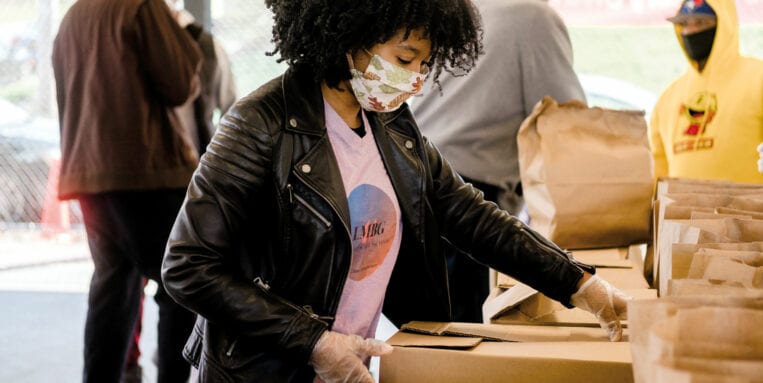
With schools closed and many people out of work, initial requests sought food, diapers and hygiene essentials. Large organizations, including the Rescue Mission Alliance, Salvation Army, Catholic Charities and the Food Bank of Central New York received grants to address those needs. So did smaller nonprofits operating food programs out of churches and community centers.
The Food Bank of Central New York had anticipated the local effect of the global health crisis. “If this pandemic hit our area, we wanted to make sure our families were ready,” said Karen Belcher, executive director. “If grocery stores closed or transport was halted, we wanted to make sure they had food in their homes.”
When New York Governor Andrew Cuomo shut down non-essential businesses, Food Bank staff moved to remote work while warehouse staff and drivers focused on getting food to its 443 programs. This included 282 emergency food programs serving 11 counties in Central and Northern New York.
The Food Bank worked with the United Way, the Community Foundation and the Onondaga County Office for the Aging to pinpoint where food was needed. “We said, ‘We have the trucks. Where does the food need to go and how can we get it there?’” Belcher explained.
About one-third of the Food Bank’s staff of 60 work in the warehouse or drive trucks. To meet the increased need, they hired two temporary warehouse workers and a temporary driver. They also had to increase phone lines. “At the beginning there were so many calls coming in we couldn’t call out. That initial panic was terrible,” Belcher said.
In March, the agency provided 34% more food than in March 2019. By April, that increase had grown to 56% over April 2019. In 2019, the Food Bank distributed 15.6 million pounds of food; in its fiscal year 2020 (ending June 30), it distributed more than 20 million pounds of food. Most of the 5-plus-million-pound increase took place from March to June, the first four months of the pandemic.
The Food Bank also coordinated with Gov. Cuomo’s Nourish New York initiative and the American Dairy Association for several mass food distribution events.
The crisis “has made people realize anyone may need emergency food and it can happen very quickly,” Belcher said. “Do you choose medication or your mortgage or food? It’s devastating.”
With child care centers closed and budgets limited by furloughs or layoffs, more families needed diapers — a basic necessity that keeps babies happy and healthy.
The CNY Diaper Bank received grants from the COVID-19 Community Support Fund to meet the increased need for diapers — which are not covered by government safety net programs — in Onondaga and Madison counties. In a typical month, the Diaper Bank distributes 100,000 diapers. In March, the Syracuse-based nonprofit saw a 50% increase in demand.
With schools closed and businesses moving to remote work, technology emerged as another big need. The Public Broadcasting Council of CNY (WCNY), for example, received a grant to support pre-K to 12th-grade instruction by teachers helping children learn from home.
Many agencies received grants to update technology so employees could stay in touch with each other and maintain connections with clients. Computers and Zoom accounts provided lifelines to constituents whose daily routines changed unexpectedly. Seniors and people with disabilities experienced isolation, and other people were at increased risk of abuse or living with substance abuse.
When it became clear the pandemic would stretch into the summer months, a $150,000 grant was given to the new Bea González Summer Fellows Program, which was designed to collaboratively fill the gap of summer youth employment programs reduced by municipalities due to COVID-19 related budget cuts. Funding was provided to PEACE, Inc., RISE, Southwest Community Center and the Building Men program to provide work readiness skills, virtual college tours, community service, citizenship, financial literacy, and experiential activities to youth during the summer months.
From their inception, the COVID-19 funds benefited from the partners’ longstanding community relationships with clients and each other. “We’re working with people who are closest to the concerns in local communities,” Dunn said.
The funds were designed with a simple application, and funders wanted money distributed quickly. “It’s a good example of collaboration among multiple funders and organizations and people on the ground to support the community in an efficient and effective way,” Dunn said.
The collaboration highlighted funders’ and agencies’ ability to be nimble and flexible. “It shows what people can do when they cooperate,” said Karen Goetz, executive director of the Richard S. Shineman Foundation in Oswego County. “It was an emergency. People just had to take all of their blinders off and work together because each of us by ourselves cannot accomplish what needs to be done in a crisis situation.”
“Our community was well-positioned to respond to a challenge few of us ever would have imagined,” United Way’s Eaton said. “People are very creative and flexible and know how to work together.”
The Food Bank’s Belcher agreed:
“We had solid-minded, calm people who said, ‘What can we do? How can we help?’”