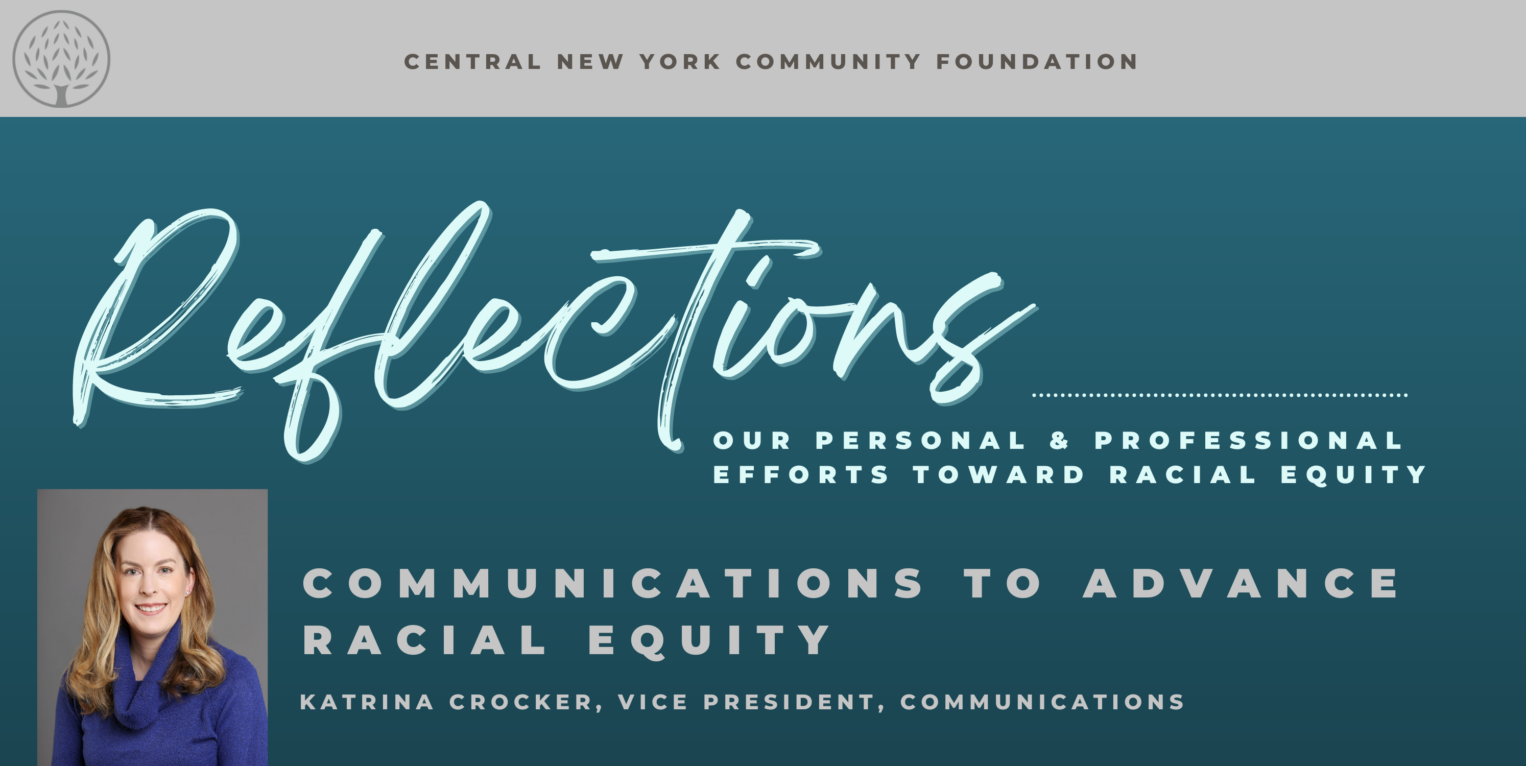
Reflections: Our Personal & Professional Efforts Toward Racial Equity is a monthly blog. Each month, a member of our staff will reflect on what they are doing either personally or professionally to improve diversity, equity and inclusion in our work. View more
Over my 14-year career in communications at the Community Foundation, I have largely considered my role to be a storyteller for good – someone who connects the larger community to the stories of our region’s most generous as well as to those who are most benefited by the charitable giving of others. But it wasn’t until we embarked on a two-year effort to build staff competencies in equity that I realized that communicators such as myself also have the power, and the responsibility, to counteract inherent bias in our society by framing conversations that advance racial equity. That is why this year we developed an extensive, internal-use guide that will help us craft relevant messaging that centers diversity, equity and inclusion.
Our Equity Communications Guide is designed to be a resource for our staff and board to communicate about diverse groups and complex topics such as racism and poverty effectively. Guidance within the manual includes clarity on how to reference groups, cultures and identities in the most respectful way possible, as well as key messages and supporting information to help people communicate about equity. We expect this document to change as we continue to learn; it will always be considered a work in progress.
One of the key concepts from the guide that could be applicable to anyone wanting to communicate through an equity lens is asset framing. Asset framing, a concept pioneered by Trabian Shorters, CEO and founder of Bme Community, refers to defining people first by their aspirations and contributions rather than their challenges. I first heard Shorters speak at the Communications Network’s annual conference in Austin a couple of years ago.
During his keynote, he explained that according to research psychologist Daniel Kahneman, our subconscious minds consistently and rapidly recognize patterns and fill in the blanks for us before our conscious thoughts even begin. These mental narratives are always being formed, and they turn our values and beliefs into simple frames that we reference instantly when we’re making decisions. For this reason, he explained, “narrative actually ends up mattering more than facts because narrative determines which facts we will credit and which facts we will ignore.”
And this means that many of us who work at charitable foundations and nonprofit organizations have been inadvertently undermining our commitment to equity. When it comes to the communities that we say we care the most about, do we first define them by a challenge, setback, or failure? Shorters explained that the narrative our audience has been exposed to most frequently determines the decisions and assumptions they make; it is not a conscious choice.
In order to break through those well-established frames and create new ones, we can consistently and accurately portray the residents we care about through asset framing. This involves defining people by what they aspire to do or how they contribute, then noting their problems and challenges (including the systemic issues that cause that challenge) and, finally, investing in them for their continued benefit to society.
“Merely the act of defining someone by aspiration sets up a cascade of associations in our mind that says that they’re actually worthy of opportunity,” said Shorters.
Here is an example that Shorters provided to illustrate this concept. Many well-meaning nonprofit organizations describe their work similar to the following: “Our program helps at-risk youth in high-crime neighborhoods stay on track, graduate, and avoid becoming a negative statistic.” He explains that this can be described in a different way that illustrates the aspirations of the youth and the challenges, most often beyond their control, that are causing barriers to their success: “Our program helps students facing extremely challenging conditions to graduate so they can fulfill their dreams for themselves and society.” In this way, we are still identifying the problem, but the student isn’t labeled as the problem.
Shorters concluded: “Stating aspirations creates associations of worth. It allows us to more easily see the obstacles that our protagonists face as the problem instead of the protagonists themselves. Therefore, the asset framing approach makes others want to address the actual problem instead of fixing the people.” At the Community Foundation, we are working to get better at applying asset frame narratives to our external storytelling. Along the way, we may not always get it right. We hope that you hold us accountable to this commitment and point out for us when and how we can do better.
To learn more about asset framing, you can listen to Trabian Shorter’s full keynote here.