Who, What, When, Why and …Where: The Usefulness of Tracking Your Clients by Census Tract

Giving Voice Spring 2020: Granting Matters

Whether it be journalism, academic research, investigations or old-fashioned problem-solving, the 5W’s – who, what, where, when and why – have become the standard expectation for evaluating and communicating a situation. Most nonprofits across the nation can rely on their passion and expertise to articulate who they serve, what they add to those people’s lives, when they do it and why. But many often struggle with articulating “where” they make a difference geographically.

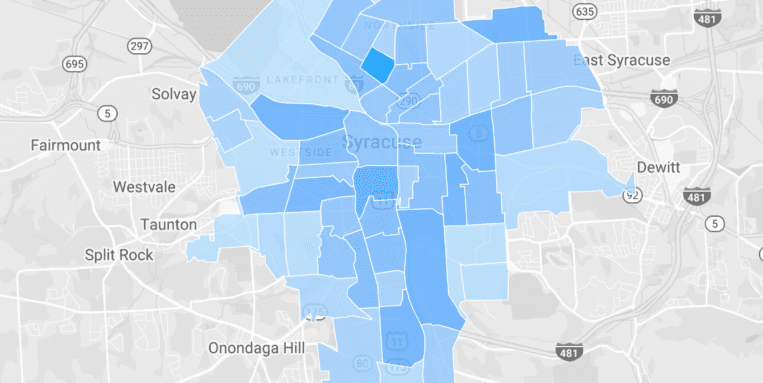
The importance of this distinction locally became most apparent after a national report ranked Syracuse as the worst in the nation for concentrated poverty among certain racial groups. This study found that our poverty numbers are worse in very specific concentrated geographies, but not within the entire city. This infamy has caused funders, nonprofit directors and community leaders to wonder whether the funding and resources they are devoting to address critical community issues are actually making it to the highest need neighborhoods. Likewise, it has made it more important for those implementing programs on the front lines to have better information regarding whether their outreach efforts are actually penetrating those key areas.

In the past, organizations relied on zip codes to analyze their work but this broad measure was simply a rough approximation that was considered “good enough.” Now that we see the difference a few miles can make, it is not effective to combine suburban neighborhoods with high-need urban tracts that, while sharing a zip code, appear worlds apart in terms of their needs and assets. Fortunately, the federal government now offers updated technology to help organizations address this challenge.

The U.S. Census Geocoder website (https://geocoding.geo.census.gov/) has been re-vamped to allow organizations to geocode up to 10,000 addresses at once. This enables them to quickly convert their long address lists into an easy-to-summarize dataset that groups people by neighborhoods. Furthermore, when they look at census data showing how many people are living in poverty, are unemployed or simply fall into a certain age group within a census tract neighborhood, they will also be able to say how many people they serve in that same region.

With this tool at our community’s disposal it won’t be long before sharing “where” we serve is just as common and precise as our efforts to talk about who, when, why and how we serve them.
Related Stories

Publicaciones December 4, 2025

Carta del Presidente

Dar voz Primavera 2025: Carta del Presidente

Blogs October 28, 2025

Qué estamos haciendo | Actualizaciones del personal del CNYCF

Nuestro personal se enorgullece no sólo de servir a nuestra comunidad, sino de forjar activamente ...

Sarah and Nikki headshots
Sin categorizar October 22, 2025

Anuncio de nuevas contrataciones

La Fundación Comunitaria Central de Nueva York ha contratado a Sarah Edlund como Directora de ...

Publicaciones September 9, 2025

El momento oportuno lo es todo: trazar los planes de donaciones benéficas de los clientes para 2025

La ley One Big Beautiful Bill hace que el momento sea decisivo para la planificación ...

Publicaciones August 22, 2025

Pago pendiente: Retrasos en la financiación de las organizaciones sin ánimo de lucro de CNY a nivel estatal

Colby Cyrus, CAPM y Frank Ridzi, Ph.D. esbozan nuestro análisis de la frecuencia con que ...

Sin categorizar July 8, 2025

LeadSafeCNY: Un vistazo a nuestras inversiones en los barrios

Un nuevo mapa de calor muestra las inversiones vecinales realizadas hasta ahora a través de ...

Publicaciones June 25, 2025

Destacamos: Susan R Schoenfeld, JD, LL.M. (FISCALIDAD), CPA, MBA

Anticipándonos a la próxima aparición de Susan en octubre, compartimos algunas de sus ideas y ...

Sin categorizar June 18, 2025

La Fundación Comunitaria anuncia los nuevos miembros del Consejo

El consejo de administración de la Fundación Comunitaria de Nueva York Central eligió recientemente a ...

Blogs June 5, 2025

Southside Connections | Crear comunidades más fuertes mediante la programación y la colaboración

En la zona sur de Siracusa, vecinos, educadores y organizaciones locales trabajan juntos para construir ...

Publicaciones December 4, 2025

Carta del Presidente

Dar voz Primavera 2025: Carta del Presidente

Blogs October 28, 2025

Qué estamos haciendo | Actualizaciones del personal del CNYCF

Nuestro personal se enorgullece no sólo de servir a nuestra comunidad, sino de forjar activamente ...

Sarah and Nikki headshots
Sin categorizar October 22, 2025

Anuncio de nuevas contrataciones

La Fundación Comunitaria Central de Nueva York ha contratado a Sarah Edlund como Directora de ...

Publicaciones September 9, 2025

El momento oportuno lo es todo: trazar los planes de donaciones benéficas de los clientes para 2025

La ley One Big Beautiful Bill hace que el momento sea decisivo para la planificación ...

Publicaciones August 22, 2025

Pago pendiente: Retrasos en la financiación de las organizaciones sin ánimo de lucro de CNY a nivel estatal

Colby Cyrus, CAPM y Frank Ridzi, Ph.D. esbozan nuestro análisis de la frecuencia con que ...

Sin categorizar July 8, 2025

LeadSafeCNY: Un vistazo a nuestras inversiones en los barrios

Un nuevo mapa de calor muestra las inversiones vecinales realizadas hasta ahora a través de ...

Publicaciones June 25, 2025

Destacamos: Susan R Schoenfeld, JD, LL.M. (FISCALIDAD), CPA, MBA

Anticipándonos a la próxima aparición de Susan en octubre, compartimos algunas de sus ideas y ...

Sin categorizar June 18, 2025

La Fundación Comunitaria anuncia los nuevos miembros del Consejo

El consejo de administración de la Fundación Comunitaria de Nueva York Central eligió recientemente a ...

Blogs June 5, 2025

Southside Connections | Crear comunidades más fuertes mediante la programación y la colaboración

En la zona sur de Siracusa, vecinos, educadores y organizaciones locales trabajan juntos para construir ...

Ver más