Nonprofits across Central New York are doing incredible work — launching creative programs, improving facilities, and building stronger organizations to serve our communities. As more and more groups bring forward innovative ideas, the number of applications to our Community Grant program has grown dramatically. This surge reflects your dedication and vision, but it also means the competition for funding is stronger than ever.
We’ve heard from you that you want greater clarity on how to position your proposal for the best chance of success. That’s why starting in 2026, we’re introducing priority focus areas to make it clearer where funding is most available in each cycle. This will help you better align your proposal with current opportunities and give your application the strongest possible chance for success.
It’s important to note that this is not a new pool of funding or additional dollars. The overall amount of money available for Community Grants remains similar to before — this change is simply about making the process clearer and more applicant-friendly.
Why We’re Making This Change
We know your time is valuable, and applying for funding takes significant effort. In recent years, the number of proposals submitted to our Community Grant program has more than doubled — from about 25–30 applications per round to 70–80 today. With funding in each program area tied to 77 separate donor-restricted Field-of-Interest Funds, we can only award a limited number of grants in each cycle. That means we’re often forced to turn away strong proposals simply because funds aren’t available in that area at that time.
By setting priority areas for each grant round, you’ll have clearer guidance on when funding in your area of work is most likely to be available. This allows you to time your application strategically and avoid spending effort on rounds where funding for your type of work may be limited.
We’ve also heard your feedback that it can be frustrating when proposals in completely different fields — like a youth literacy program and a senior center renovation — are weighed against each other. Priority areas will allow us to review “like with like,” resulting in a more straightforward evaluation process and helping us make more consistent funding decisions.
Now, with priority areas assigned to each round, we can deploy those dollars in one grant round instead of splitting them over two, which increases transparency and ensures funding flows more quickly to applicants.
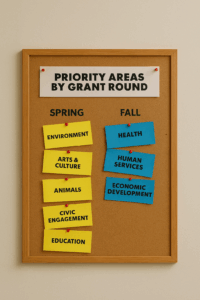
Fall Round (August 29, 2026 Deadline): Health, human services, economic development
projects
FAQ
Q: Can I still apply in either grant round?
A: Yes, you can apply in either round. However, each round will prioritize certain focus areas. This change is designed to help you plan ahead, tailor your application, and apply in the round that best fits your project. Please note: the overall dollars available for Community Grants are not increasing — this is not a new funding opportunity.
Q: What will be the priority areas for each round?
A: The spring round will prioritize arts & culture, environment, animals, civic engagement, and education. The fall round will prioritize health, human services, and economic development.
Q: Will the types of projects you fund change?
A: No. We will continue to fund programmatic, capital, and organizational development projects. This process change only affects how funding priorities are organized each round.
Q: What if I am unclear which round I should apply to?
A: We require all applicants to speak with staff before submitting. We also encourage conversations throughout the year to help you determine which round offers the best fit and timing for your proposal.