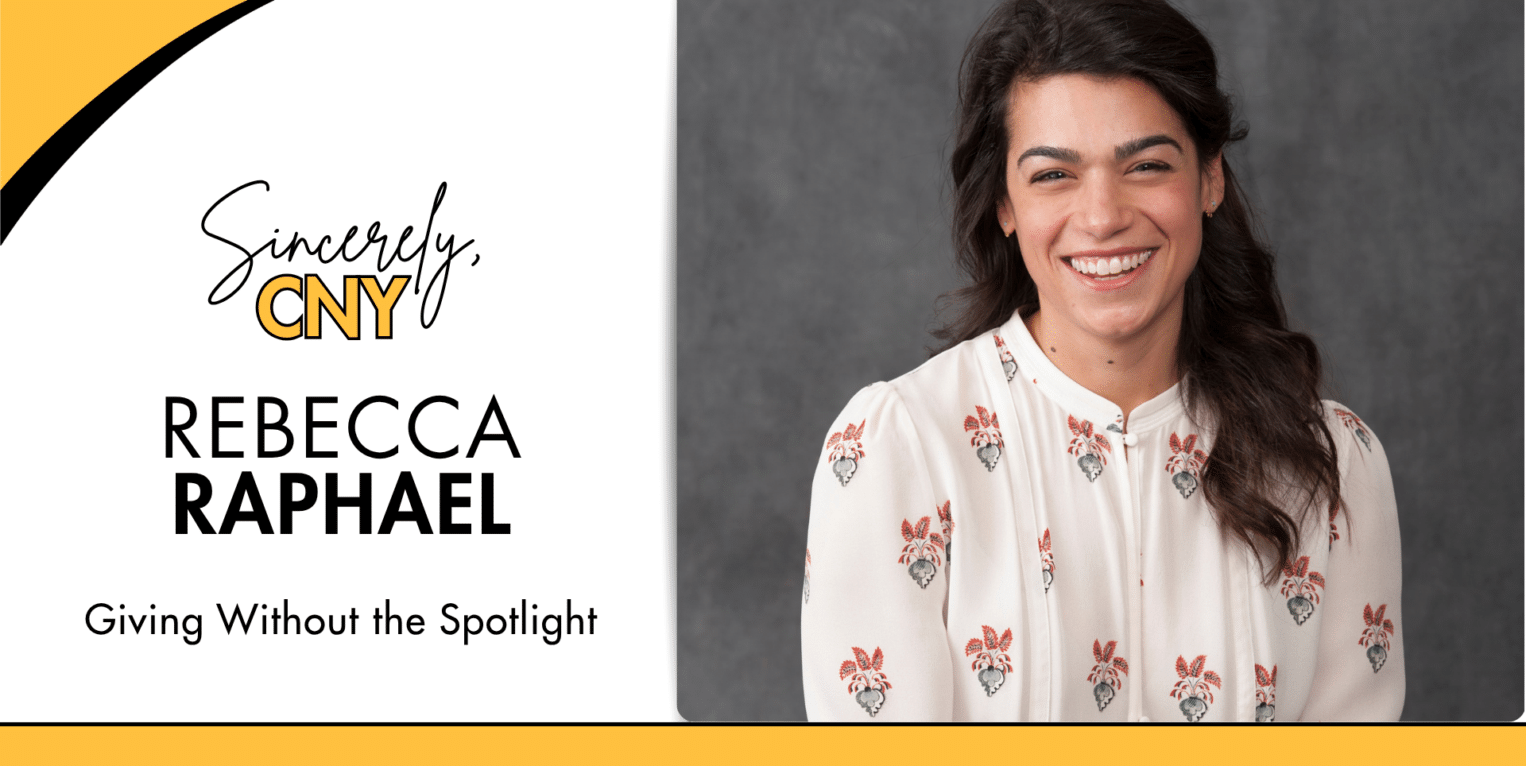
Sincerely, Rebecca Raphael: Giving Without the Spotlight (Transcript)
[00:00:00] Melanie Littlejohn: Today’s episode is a love letter to the people who are shaping Central New York, oftentimes in quiet ways, but always in powerful ways. I’m Melanie Littlejohn, and welcome to Sincerely CNY.
Today’s guest is the chief strategy officer at Curio Wellness, and a passionate advocate for family-centered philanthropy. Originally from Baltimore, she began her career working with galleries, museums, and art collectors before joining her family’s science-driven wellness company. She and her husband, Brad, are now raising their three children in central New York, where she has become deeply involved in philanthropy and [00:01:00] community service.
A former board member of the Central New York Community Foundation’s board of directors, she is committed to making generosity a natural part of family life and creating a legacy of kindness, service, and connection for the next generation. Please welcome today’s guest, Rebecca Raphael. Good after- no.
Morning? Noon?
[00:01:26] Rebecca Raphael: I don’t
[00:01:26] Melanie Littlejohn: know.
[00:01:27] Rebecca Raphael: It all blends together. Just welcome.
[00:01:28] Melanie Littlejohn: I know. Hi.
[00:01:29] Rebecca Raphael: How you
[00:01:30] Melanie Littlejohn: doing? How are you?
[00:01:31] Rebecca Raphael: I’m good. I’m good. I’m busy.
[00:01:33] Melanie Littlejohn: I love that. Yeah. I love that you are sitting in the cushy green chairs, um, here.
[00:01:40] Rebecca Raphael: It’s, it’s very nice and, and warm and cozy and-
[00:01:43] Melanie Littlejohn: Yeah …
[00:01:43] Rebecca Raphael: yeah. Yeah. Like
[00:01:44] Melanie Littlejohn: a good hug. That’s exact- yeah.
Hopefully that’s what you will experience. And, um, that’s a part of what we wanna make sure that we communicate, the warm hug from the Central New York Community Foundation. Mm-hmm.
[00:01:58] Rebecca Raphael: Yeah.
[00:01:59] Melanie Littlejohn: You know [00:02:00] us.
[00:02:00] Rebecca Raphael: I do.
[00:02:00] Melanie Littlejohn: And, um, we’ve had the privilege of getting to know you as an organization. Now let everyone who’s listening, um, hear a little bit about what motivates Rebecca.
[00:02:16] Rebecca Raphael: So there’s, I’d say two, two things. There’s personal perfectionism, which I’ve had probably out of the womb- Mm-hmm … my parents would tell you. Um, and then there is family. And when I say family, I mean creating an environment and creating a, um, example for your children, and having moved to central New York where my husband’s from, candidly have an example for my extended family, my in-laws, my sister-in-laws, brother-in-laws, and my nieces and nephews, of what it means to show up for the people in your life.
Um, and there’s a, there can be a push/pull there- Mm-hmm … because you really, in the, the suit of, pursuit of [00:03:00] perfectionism and working hard and being successful, um, you can sacrifice a lot of time with your family. Mm-hmm. Um, but over the years I’ve learned that I can do both, and it’s really okay, especially for my kids, to see that working hard and staying up late and having to travel and do all of these things is okay, and it’s not gonna be the end of their lives ’cause, like, I’m not there to make dinner.
[00:03:23] Melanie Littlejohn: Right. Right. Yeah. Right. You know, when I, um, was preparing for this discussion-
[00:03:29] Rebecca Raphael: Mm-hmm …
[00:03:30] Melanie Littlejohn: I, um, you know, read a lot about you and read a lot about your- Oh, gosh, what’s out there? No, no, it’s all good. It’s all good. But, and just even some of the interviews that we’ve done with you as a foundation in the past because of, um, your family and your family generosity Um, your parents
[00:03:54] Rebecca Raphael: Yeah, I like them a lot.
[00:03:56] Melanie Littlejohn: Yeah. Your parents, um, [00:04:00] they taught you or instilled in you the, uh, notion of service.
[00:04:05] Rebecca Raphael: Mm-hmm.
[00:04:06] Melanie Littlejohn: Talk to me about that.
[00:04:07] Rebecca Raphael: Yeah, so they… I grew up, um, in a very fortunate household because filled with a lot of love. My dad, much like me, worked like eight days a week. I mean, I used to joke that, you know, he would go out of town and I wouldn’t see him for like two or three days, and it was on day four if he didn’t come back that you’d be like, “Uh, is Dad ever coming back?”
Um, but we were so used to him being out of the house. And when he would be home for dinner, we would do fun things like go out for ice cream. So we had this example of someone who put in the time and the commitment, not only to be financially successful, because my parents never talked about money. We– I like, I never knew how much money we had.
I never knew when they sold their business, how much they sold it for. Um, but it was always about, “I’m gonna build something and it’s gonna give us privilege and it’s gonna give us access and the ability to do a [00:05:00] lot of things-” Mm-hmm … big or small. So that was kind of what he modeled, and then he always referred to my mom as the CEO of the house.
Mm-hmm. So he never undermined her decision-making. If it had to do with how we were being raised, they were always a united front, but like the buck stopped with her.
[00:05:16] Melanie Littlejohn: Mm-hmm.
[00:05:17] Rebecca Raphael: And then as it relates to service, um- They were very modest in how they would give. Like, they didn’t do… Even as they got more successful and they would give, like, a big gift to the Associated or to our synagogue, it was never the Michael and Jessica Bronfin blah, blah, blah.
It was an anonymous gift. Mm. Um, and we saw both giving of money, there was a lot of giving of time. They served on boards, they served on different committees. Um, and we joke, when we started Curio, and we felt like we were going to build something that was gonna enable us to not only set our families up for success, but have a means to give back to [00:06:00] the community, uh, my sister and I would joke that foundation meetings are on Tuesday nights.
And it was born out of the fact that that was the night that my mom would go to Associated or whatever else they were working on, but Tuesday night was always off limits because they had their community commitments. And so we were just basically mocking what we had seen.
[00:06:20] Melanie Littlejohn: Yeah.
[00:06:21] Rebecca Raphael: And so that has continued to be the joke, of like, we need to work really hard.
We need to grow this thing, because foundation meetings are on Tuesday nights, and, like, we’re gonna have… We’re gonna need something to do and talk about. Right, right, right, right. Um, but yeah, they, they modeled what I would call kind of quiet or selfless giving.
[00:06:38] Melanie Littlejohn: Mm-hmm.
[00:06:38] Rebecca Raphael: Um, and what’s really interesting is that over the past six months, I’ve been made aware of a lot of things that they did throughout my life and my siblings’ life that they never talked about.
[00:06:52] Melanie Littlejohn: Wow.
[00:06:52] Rebecca Raphael: And so it’s very cool to be a parent and to model for them, for my children, like You [00:07:00] can give people money, you can give people access, you can help them have experiences, and you do not need to take any credit for it. And no one candidly should know that you did this thing, because it’s not about getting the attention, it’s about changing the life of the person or the, the organization that you’re giving to.
Mm-hmm. Um, and I try really, really hard in my household to pass that lesson along. ‘Cause I think that selflessness is super rare, especially having worked in development in Los Angeles, which is a crazy beast. Mm. Um, you just don’t see a lot of that, and I think it’s super cool to be able to have that confidence and also the ability to do it.
[00:07:40] Melanie Littlejohn: I love the mantra also that I heard is attributed to your parents, um, for every dollar we earn, we give, too.
[00:07:49] Rebecca Raphael: Yes. Yes.
[00:07:50] Melanie Littlejohn: And, um, that, and like you said, it’s not just about the dollars- Mm-hmm … because they did it with service as well.
[00:07:58] Rebecca Raphael: Yeah.
[00:07:58] Melanie Littlejohn: You all used [00:08:00] to do family things together, um, in service.
[00:08:05] Rebecca Raphael: We did. We, like the best memory I have, Thanksgiving is like the Super Bowl in our family.
Mm. And my parents and my aunt and uncle started a chain of retail pharmacies when we were young called Neighbor Care. Mm. And from the earliest days, the Neighbor Care staff, even as it grew, would go to a men’s shelter in downtown Baltimore the morning of Thanksgiving, and we would cook Thanksgiving dinner for the people living in the shelter.
Mm-hmm. Um, and as it grew, we went from just being at a men’s shelter, to this like beautiful woman named Shirley Craig, who would organize the whole thing, then found two women’s shelters because so many people wanted to get involved. And they allowed little kids to come. I mean, I think I was probably like six or seven, like young when I was first there.
[00:08:48] Alayah Green: Mm-hmm. Mm-hmm.
[00:08:48] Rebecca Raphael: Um, and my other uncle, who was a part of the business, became the person who had certain roles in the kitchen, but it was always how we started Thanksgiving. And so we’ve thought about [00:09:00] how to bring those same acts of service into our current company.
[00:09:04] Melanie Littlejohn: Mm-hmm.
[00:09:05] Rebecca Raphael: Again, to just model that behavior for people so they understand, like philanthropy isn’t writing a million-dollar check.
It’s spending two hours somewhere that you would’ve never gone otherwise, and, you know, taking the load off that organization, showing up for people who you wouldn’t interact with otherwise. Um- And it, it was just fun too. So-
[00:09:25] Melanie Littlejohn: Yeah. It was- And makes your heart feel good too.
[00:09:28] Rebecca Raphael: Yeah. Yeah.
[00:09:29] Melanie Littlejohn: And it, and hopefully a part of what we wanted to do through this podcast is inspire others to figure out how they want to be of service or inspire others through someone else’s journey in life.
[00:09:45] Alayah Green: Mm-hmm.
[00:09:46] Melanie Littlejohn: Um, because we know that giving shows up in all kinds of ways. Right here at the foundation, there are multiple ways in which- Yeah … someone can give. But we just want to plant that [00:10:00] seed. So these conversations, my friend- Mm-hmm … are really, really important. And you, you know, when I think about some of what you have done right here at the foundation, um, you have helped us think through How to, um, talk and engage people in this whole discussion of philanthropy.
Is there any one defining moment that you’ve had as a former board member, as a committee member, that made you understand the, the true impact of what you’ve done, um, f- not only for this organization, but for this community?
[00:10:46] Rebecca Raphael: Oh, my goodness. I don’t, I can’t think of a, of a single moment or time. And I would also say that, like, it is not a, you know, individual contributor sport.
Like, the team here is [00:11:00] brilliant, and having worked at a nonprofit, like, they are just… There’s no comparison to the talent of the individuals at the foundation and how much they care about the work that they do. So as board members, we’re not really here to tell them what to, what to do. We’re here to kind of be a, uh, sounding board.
Like, “Did you think about this when you were considering that?” Like, “Is there a reason why we’re giving to this organization but not that organization?” Um, really ask them questions about why they want this amount of money. So, um, we’re kind of like a human gut check- Yeah … if you will.
[00:11:35] Melanie Littlejohn: Yeah.
[00:11:35] Rebecca Raphael: Um, but I think working, I worked really close with the development committee and the marketing or the communications committees, um, and I just found it so interesting that we track so much data.
Like, you think this is kind of like a soft business, and that it’s about growing relationships and learning people’s family life and their [00:12:00] experiences and how they’ll give back to the community, you know, perhaps later in life. Um, but it’s all ch- like, grounded in the numbers.
[00:12:09] Melanie Littlejohn: Mm-hmm.
[00:12:09] Rebecca Raphael: And that actually was more impactful for me, as someone who works in sales and marketing, and thinking about, am I as rigorous about what I do day to day as Katrina is about the traffic on the website?
Um, so I, I think I learned more from them than they probably learned from me. Yeah. Um, but it’s a, it’s, it’s just a really good think tank of individuals. Mm-hmm.
[00:12:34] Melanie Littlejohn: Yeah. Um, y- y- you know, I do get a chance to work with some really brilliant people-
[00:12:40] Rebecca Raphael: Mm-hmm …
[00:12:40] Melanie Littlejohn: um, that have hearts the size of y- y- you know, the Dome- Yeah
if you will. Uh, it’s This, this work is heart work.
[00:12:53] Rebecca Raphael: Yes.
[00:12:53] Melanie Littlejohn: Right? Yes. That’s driven by data helps tell the story.
[00:12:56] Rebecca Raphael: Mm-hmm.
[00:12:57] Melanie Littlejohn: Um, and you and [00:13:00] our board, our other, um, friends that are b- our donors, our community partners. When I think through this work, it’s all about, um, collaboration. And, and so I continue to be inspired by how you think about collaboration.
50 years from now What do you think in the, the, the grand scheme of collaboration and family and community, what do you want your legacy to be?
[00:13:37] Rebecca Raphael: Oh, I didn’t think that’s where you were going with that question. Um, what do I want my legacy to be? Uh, kindness. Like, you just want… Like, your reputation is all you have at the end of the day.
Um, health comes and goes, money comes and goes, you know, houses come and… Like, it’s all, all the stuff is transient. What [00:14:00] people say about you, and how they remember you, and how they talk about your, not just, like, Rebecca, but, like, the Raphael family or the Bronfein family, um, that’s what’s important to me.
So yeah, I mean, my parents used to say to us, “When you go out of this house, you represent us.” Mm-hmm. Like, “You’re, you’re just kind of a walking representation of our family, and so make sure that everything you say and do and how you act would, you would be comfortable with, and you would make us proud.” Um, and I think it was one of the most indelible things they taught us, ’cause I see myself doing it with my kids.
But at the end of the day, it’s all about what are, what are people gonna say about you at your funeral? And I hope they say, like, “She was incredibly thoughtful. She was intentional with how she treated people. Um, she made sure those around her were taken care of, and, you know, she kinda gave a shit.” Like, Like, there was not a lotta wasted moments.
But- Yeah, yeah … [00:15:00] um, yeah, I, I think it’s really about kindness and-
[00:15:03] Melanie Littlejohn: Yeah …
[00:15:03] Rebecca Raphael: and making sure that you’re a good person.
[00:15:05] Melanie Littlejohn: Yeah. Yeah. So. You said something in one of, um, in, in one of the things that I read, and you said that philanthropy should be as normal as paying the electric bill.
[00:15:22] Rebecca Raphael: Yeah. The thing that I find is, like, my kind of inner temperature check- Yeah
is how much Starbucks have I bought this month?
[00:15:32] Alayah Green: Mm.
[00:15:32] Rebecca Raphael: And if I get, like, an opportunity, if someone says to me, “Oh, my child’s having a fundraiser at school,” or Girl Scout cookies or whatever it is, and if I hesitate or if I am giving less to that organization than I gave to Starbucks this month, then we have a problem.
So that’s the, that’s the type of thing, because I, I always say to people who are either hesitant about giving or saying, “Oh, I, you know, we don’t really have the means” [00:16:00] My inner voice is going, “I mean, I know how much coffee you buy.” Like, I do. Um, but then I try and have the conversation with people around, like, “Well, let’s think about that.
Like, think about your spending. Think about how you’re choosing to spend your dollars or choosing to spend your time.” If you genuinely are someone who doesn’t have a monetary- Mm-hmm … philanthropy budget- Mm-hmm … um, just make giving, in any sense of the word, a normal act in your day-to-day. It should be like brushing your teeth.
Yeah. So, like, the for every $1 we make, we should give away $2. Um, you know, that’s… I don’t even think about it at this point. I’m just like, “Well, if I can afford to do X, Y, and Z, I have to be able to afford to give money away or give time away.”
[00:16:45] Melanie Littlejohn: Right.
[00:16:46] Rebecca Raphael: Yeah.
[00:16:46] Melanie Littlejohn: Right. Rebecca, you know who you really are?
[00:16:49] Rebecca Raphael: I, I don’t know.
[00:16:51] Melanie Littlejohn: Yeah. I don’t know. Let, let me tell you.
[00:16:53] Rebecca Raphael: Okay. Let
[00:16:54] Melanie Littlejohn: me tell you.
[00:16:54] Rebecca Raphael: Enlighten me. Let me
[00:16:55] Melanie Littlejohn: tell you, Bec. You are a honest, good soul.
[00:16:58] Rebecca Raphael: Oh, thanks, Mel.
[00:16:59] Melanie Littlejohn: From [00:17:00] the moment I walked into these doors, um, you welcomed and embraced me. You gave me good Feedback, um, a- in the words of my dear dad, you gave me stuff straight, no chaser.
And I think that’s important, right? That is important to bring good people- Mm-hmm … to the table that come and approach philanthropy from so many different perspectives. Mm-hmm. Because what we’re learning now in this moment, like we’ve never knew before, that, um, together we’re all so much stronger.
[00:17:46] Rebecca Raphael: Absolutely.
[00:17:47] Melanie Littlejohn: And that in order to drive impact to change lives, to help build resilient communities, it takes a Rebecca Rayfield.
[00:17:59] Rebecca Raphael: Oh, [00:18:00] thank you.
[00:18:00] Melanie Littlejohn: And it takes people who have both the heart and the compassion to drive change. So thank you.
[00:18:08] Rebecca Raphael: Thank you. No, I think you have to have interests, um, outside of your bubble.
[00:18:15] Melanie Littlejohn: Mm-hmm.
[00:18:15] Rebecca Raphael: Um, I think it’s really easy to get wrapped up in I’ve got work, I’ve got dance practice, I’ve gotta drive them to lacrosse pra- I mean, there’s a thousand reasons why you are not gonna pay attention to the community around you. Um, candidly, I used it as a way to make friends. I moved to a new place where I didn’t know anyone.
Um, I was fortunate to have, uh, wh- what my good friend Taylor Brown, who I refer to as my cruise director- … introduced me to a handful of people who, that’s how I met Andy Brewer. And Andy said to me one day, “I’m on this foundation board. We have open seats. It’s about a two million year commitment to serve on the board.”
[00:18:57] Melanie Littlejohn: Oh, yes. “
[00:18:58] Rebecca Raphael: And you are [00:19:00] gonna meet really interesting people.” And it was at a time when I was here where I had become very involved with the federation. Mm-hmm. Um, and being inside of the Jewish philanthropy world was, like, my comfort zone, so it was very easy to start there.
[00:19:14] Melanie Littlejohn: Mm-hmm.
[00:19:14] Rebecca Raphael: But it was also easy to take a step back and hear what he had to say about the foundation and realize I don’t really have exposure and I’m not learning about this place that I live because I’m just in this one lane.
Um, and you’ve heard me talk about this book, Extreme Ownership, that I’m obsessed with. Mm-hmm, mm-hmm. But a tenant of it is this notion of breaking down silos. And so when I think about- Kind of how I live my life now as a result of that book and its learnings, um, and what I was doing then, I was just in a silo.
And so the foundation enabled me to break out of that silo- Mm … and learn about Lead Safe, learn about, uh, uh, the programs to send Syracuse City Schools to [00:20:00] college.
[00:20:00] Melanie Littlejohn: Say yes.
[00:20:00] Rebecca Raphael: Yes, exactly. Mm-hmm. Um, and then I also met all of these incredible professionals, both at the foundation and the board members, where now, as opposed to having to, like, blind message someone on LinkedIn, like I can call Susan.
I can call- Yeah … Steve Jacobs. Yeah, yeah. Like, there’s, there’s all this cool networking that happens. Um, so selfishly, it was this way to, like, create a network in an unknown space that ended up being far more fulfilling than that, but that’s really how it started. So you just have to have, like, a little bit of curiosity- Mm-hmm
and a little bit of bravery to go outside your bubble, and you could be really pleasantly surprised with what you find.
[00:20:41] Melanie Littlejohn: Thank you.
[00:20:41] Rebecca Raphael: Yeah.
[00:20:42] Melanie Littlejohn: Thank you.
[00:20:43] Rebecca Raphael: Mm-hmm.
[00:20:44] Melanie Littlejohn: Sincerely, CNY. This is Rebecca Raphael. Thank you.
[00:20:52] Patrick Murphy: My name is Patrick Murphy. I was born and raised in Syracuse. My brother and I are now the third-generation owners and operators [00:21:00] of, uh, Murphy & Nolan.
[00:21:01] Kim Murphy: My name is Kim Murphy. I moved to Syracuse in 2007. I’ve been involved in a number of organizations.
[00:21:08] Patrick Murphy: Anyone that is considering, uh, including a philanthropic mission in their estate planning, the Community Foundation is a great resource to do that. You know, estate planning brings up a lot of difficult conversations that nobody really wants to address, but it does provide a very important tool in making sure that the legacy that you wanna continue or the hard work that you’ve put in thus far, um, gets continued on.
[00:21:34] Kim Murphy: We both are heavily involved in multiple organizations in the community, and they’re very near and dear to our hearts. So for us particularly, it’s very nice to know that we will continue their mission, um, beyond us.
[00:21:51] Melanie Littlejohn: Welcome back. This is quickly becoming one of my favorite segments of the show, and it’s called PS: The Next [00:22:00] Chapter. And this is a spotlight where we feature a series of young leaders from across central New York who are creating change through generosity and service and action. Each of these conversations gives us a glimpse into the passion and purpose driving the next generation of philanthropy in our community.
Take a look Hi, Alaya Green. How are you?
[00:22:34] Alayah Green: I’m good. How are you?
[00:22:36] Melanie Littlejohn: Good, good, good. Thank you so, so, so much for joining me today. Um, I think one of the things I would love to begin with, um, is about when I first met you and how you have stuck in my heart and in my spirit since I met you. Um, [00:23:00] I started my job about two years ago, and I went to an event that you were being honored for your work, um, with Make-A-Wish.
And I was so struck by, um, not only your, um, kindness and about the work that you’re doing, um, to help other children, uh, who not only are in the midst of, um, wanting and needing a wish, but also on what survivorship looks like. But I was also really, really inspired by, um, your poise and how graceful you are and how you’re just a regular cool kid.
[00:24:00] So Alaya, thank you and welcome. And I want you to tell everybody, um, who is listening today, um, about who you are and what makes you happy and gives you a lot of joy
[00:24:16] Alayah Green: Um, okay. So what makes me really happy, like, every day is waking up and seeing my family when I go downstairs to make breakfast. Uh, especially with everything really hard that happened, I think it’s really nice to see my family in the morning.
Um, but also just always see my family. Um, on my bed, there’s a, a bulletin board with pictures of me and my friends and my, uh, my cousin who went through a lot of hard stuff last year. Um, [00:25:00] her name is Evelyn.
[00:25:02] Melanie Littlejohn: Mm-hmm.
[00:25:02] Alayah Green: And I think just having those pictures is really nice to see. It makes me really happy to see them.
[00:25:10] Melanie Littlejohn: Yeah. You know, um, uh, what I want when people see you and hear you, I want them to see and hear that, um, you are a thriving young woman. And I want people to see that part of you and also understand as that everyone can do something. And when I see you, Miss Alayah Green, that’s what I see, that everyone can do something.
And, um, can you talk to us about Your work with Make-A-Wish, um, and your ride-a-thon
[00:25:58] Alayah Green: Yeah, I can do that. [00:26:00] Um, so when I was in first grade, um, I ended treatment, uh, at the end of kindergarten, and I went up to my mom and I was like, “Mom, I wanna do something really cool.” She was like, “Well, what do you wanna do?”
And I was like, “I would like to do something for Make-A-Wish.” She was like, “Okay.” So she talked to Make-A-Wish, and they were like, “Well, let’s do something that raises money.” And when I was in Florida for my wish, um, that they granted me, it was so magical. I was in love with the princesses. Mm. Uh, Elsa was my favorite, and I would get all their autographs.
And, uh, I remember, uh, the carousel, I would ride for, like, hours straight every day. It was my [00:27:00] favorite thing there. Yeah. And we were like, “Why not we do something from her wish to bring that back?” So we decided to go to the mall and ask to ride the carousel for one day every year to raise money for Make-A-Wish.
And they were like, “Why don’t we do the whole weekend instead?” Wow. And, uh, my mom was really shocked that they would let us do that. So, uh, we ride it for the weekend every year, and all of the ride admissions, uh, get donated to, um, Make-A-Wish. And, um- I ride all weekend. Uh, the most times I’ve rid the carousel was 157.
Um-
[00:27:55] Melanie Littlejohn: Wow.
[00:27:56] Alayah Green: Yeah. Wow. I tell everyone I’m not dizzy, but [00:28:00] I get very dizzy.
[00:28:02] Melanie Littlejohn: Well, yeah, I- wow, 157 times. Wow.
[00:28:08] Alayah Green: Yeah. Um, but it’s also not just me and Make-A-Wish that help. Um, family’s a big supporter for it. Um, my grandparents make really big donations every year. Um, the Morrisville girls hockey team has come for the past three or two years, um, and they help a lot.
Um, other people, strangers, post online about it, which helps a lot as well, and the mall especially, I mean, we wouldn’t be able to do this if they didn’t let us.
[00:28:46] Melanie Littlejohn: Right. Right. Right.
[00:28:49] Alayah Green: And, uh-
[00:28:50] Melanie Littlejohn: That is so cool. What would you tell Uh, say all the kids who were trying to think [00:29:00] about how they could give to something that they care about, what advice would you give to them in terms of how to do something so impactful like you’re doing?
[00:29:15] Alayah Green: Um, I would start off by saying, um, do something that means something to you. Because I think if you do something that meant a lot to you, you can feel a lot more when you’re doing it, because you know how much it impacted you. So it would impact a lot of other people. And if it impacts a lot of other people, it would not just be raising money and this is great.
It would make people feel like, “Wow, that’s really special that they’re doing that.” And it would leave an impact for them to tell somebody else about it. So I would tell them that. [00:30:00]
[00:30:01] Melanie Littlejohn: I think that’s such good advice, not only for, um young people, but I think that’s good advice for all of us, right? Do something that touches your heart and that you think could make a difference for another human being.
That is such, such powerful, powerful work. Do you think, Alayah, that doing the work you do for others, um, h- how do you think Do you think it’s important to recognize this work so that it gets bigger and bigger?
[00:30:56] Alayah Green: Yeah, I definitely think it’s important to [00:31:00] recognize everything that goes into it because, um, well, this is my seventh year of doing this, and when I first started, it was pretty small-
[00:31:12] Melanie Littlejohn: Mm-hmm
[00:31:12] Alayah Green: but it was still really amazing watching it. But over the years I’ve noticed every year it’s bigger and there’s a lot more people, and you raise a lot more money year after year. Because when you highlight all of the details, and there’s more details, um, it really leaves an impact because if you stick with it and you let it grow, it becomes something very powerful and big for people to see that someone could do that.
[00:31:49] Melanie Littlejohn: Well, Miss Alaya Green, I gotta tell you, you are powerful unbelievable [00:32:00] human being. I wish there were so many more people in this world just like you. Thank you for all that you are doing to make the lives of so many, so many young people who are going through, um
On your road to survivorship, cancer survivorship. Thank you, um, for leading the way and making and shining a light, um, and creating so much positivity. You are a beautiful soul, young woman.
[00:32:43] Alayah Green: Thank you.
[00:32:44] Melanie Littlejohn: And keep doing it. Keep doing it, ’cause the world needs you and so many people like you. Um, there’s a reason you stuck in my heart There is such a reason you’re stuck in my heart, [00:33:00] and, um, you- thank you for being the best part of my day.
Um, and I look forward to all of the amazing things that you will do.
[00:33:14] Alayah Green: Thank you.
[00:33:15] Melanie Littlejohn: And please know all of us will continue to keep our hands on your back and on your shoulders to enable you to continue to do this great work. If you’d like to nominate someone to be featured in our PS the Next Chapter segment, please scan the QR code on the screen or reach out to us at, uh, cmycf.org/podcast.
And, uh, share someone with us. Share a young person’s name with us. We’d love to feature them. You know, when I do these segments, the piece for me that becomes really important is to inspire action. [00:34:00] Inspire action in a way that the Rebecca Rae Fields and her family have done. Um, when we think about action, I want us to think about philanthropy as normal as paying the electric bill.
I want us to think about for every dollar that is earned, two dollars is given. I want you to think about ways in which service is also a form of philanthropy. That giving of your time and of yourself is just as important. What we want to inspire through this podcast is this notion that if you care about literacy, if you care about lead and lead reduction, if you care about the eradication of poverty, whatever those things are that you care [00:35:00] about, that you can find a space in which you can drive impact yourself.
Because we know together we’re, we are all so much stronger. So Central New York, lean in. Reach out. Reach out to places like the Foundation or reach out to organizations that you care deeply about. Commit, connect- And guess what? Always use love to drive change. As we close out, I wanna thank our guests, Rebecca Raphael, and, and this podcast would not be possible without the brilliance of our production team, Dana, Corey, Anna, Katrina, Juliet, Austin.
Thank you. The Community [00:36:00] Foundation is a place, a place of giving, a place where impact lives, and we are proud, um, that you’re joining us for this conversation. So stay tuned, and we look forward to talking to you again soon
News & Stories
Central New York Community Foundation Announces Promotion
The Central New York Community Foundation has promoted Darrell Buckingham to Director of Strategic Initiatives ...
Cultivating the “Big Bequest”: Paving the Way for a Bright Future
Transformational legacy gifts often begin with small acts of generosity and meaningful donor relationships. Discover ...

Year-End Punchlist: Start Checking It Twice
Year-end fundraising is about more than donation appeals. Explore seven practical strategies to strengthen donor ...
Engaging the Next Generation Through Philanthropy: A Guide for Professional Advisors
A new resource guide featuring insights from Pragya Murphy, our Director of Philanthropy & Impact ...
A Century of Giving: Building Tomorrow, Together
Sponsorship Opportunities.
Booker T. Washington Center Chosen by Cayuga County Residents to Receive $75K for Youth-Focused Project
The winning grant will be used to create a countywide teen resource program. The program will ...
Cayuga County Residents Invited to Vote on Community-Designed Projects for $75,000
Winning Project to be Announced at October 1 Community Celebration

Tips on getting your stocks in a pile (and other reminders)!
As clients turn their attention to year-end tax and financial planning, now is an ideal ...
Central New York Community Foundation Welcomes New Hire
The Central New York Community Foundation has hired Madeline Thibault, Esq., as Philanthropic Advisor.
Central New York Community Foundation Announces Promotion
The Central New York Community Foundation has promoted Darrell Buckingham to Director of Strategic Initiatives ...
Cultivating the “Big Bequest”: Paving the Way for a Bright Future
Transformational legacy gifts often begin with small acts of generosity and meaningful donor relationships. Discover ...
Year-End Punchlist: Start Checking It Twice
Year-end fundraising is about more than donation appeals. Explore seven practical strategies to strengthen donor ...
Engaging the Next Generation Through Philanthropy: A Guide for Professional Advisors
A new resource guide featuring insights from Pragya Murphy, our Director of Philanthropy & Impact ...
A Century of Giving: Building Tomorrow, Together
Sponsorship Opportunities.
Booker T. Washington Center Chosen by Cayuga County Residents to Receive $75K for Youth-Focused Project
The winning grant will be used to create a countywide teen resource program. The program will ...
Cayuga County Residents Invited to Vote on Community-Designed Projects for $75,000
Winning Project to be Announced at October 1 Community Celebration
Tips on getting your stocks in a pile (and other reminders)!
As clients turn their attention to year-end tax and financial planning, now is an ideal ...
Central New York Community Foundation Welcomes New Hire
The Central New York Community Foundation has hired Madeline Thibault, Esq., as Philanthropic Advisor.