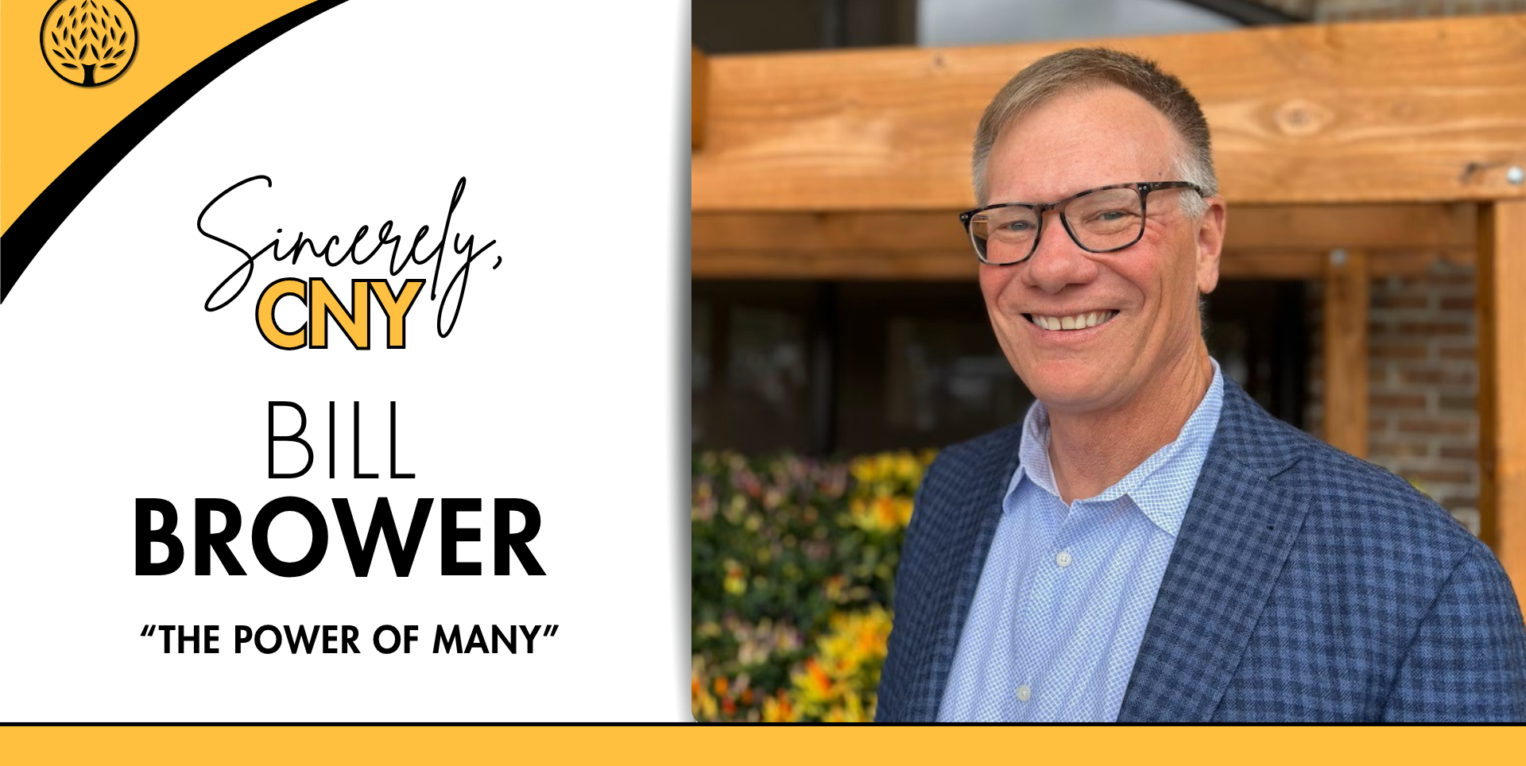
Sincerely, Bill Brower: The Power of Many
FULL TRANSCRIPT:
Melanie: Today’s episode is a love letter to the people of Central New York who are shaping this region in powerful and sometimes quiet ways. I’m Melanie Littlejohn, and welcome to Sincerely, CNY.
Sincerely, CNY is an opportunity to highlight voices and stories and the power of many people who are making a difference in this region. We thought it was really important for the Central New York Community Foundation to elevate these voices that are driving and creating impact across our region, to really tell the untold stories of philanthropists young and old.
It’s an opportunity for us to celebrate all the good that’s happening right in our backyard. And why did we choose a podcast? Because it allows us to have those meaningful and deep conversations in ways that other forums would not necessarily allow. We are excited to share these stories of people who are doing and creating monumental change right in the place we call home.
Today, I am thrilled to introduce both a friend and a colleague. It’s just a joy and a privilege to have him sit here with me today. Our guest today is the director of public policy and community impact at MACNY, The Manufacturers Association of Central New York, and he has been a driving force for decades in Central New York across higher education, philanthropy, and workforce innovation.
Known for building partnerships that turn growth into opportunity, he has helped strengthen institutions, expand access, and support this region’s long-term economic future. I am so excited to welcome a Community Foundation board member, a dedicated community advocate, and most of all — and most importantly — my good friend, Bill Brower. Bill.
Bill: Hello.
Great to be here with you, Melanie.
Melanie: Oh, thank you for being here. When I read your bio, there were things in your bio I had no idea about. I had no idea how you even arrived in Central New York. More importantly, I had no idea you wanted to be a doctor at one point.
The more I read your bio and the more I read about you, a couple of things became really obvious to me. You’re a pretty good human being. You’re a really good human being. But tell me: why does the work you do today matter? One, how has it shaped you? And more importantly, how do you think who you are and what you do impacts Central New York?
Bill: Great question. Thanks for having me. It’s so good to be here. I consider you a great friend as well. I know my time on the board is getting close to the end — we’re working on that — but hopefully we’ll figure out ways that I can continue to contribute and support what you all are doing here.
I think I was incredibly fortunate to have the parents I had, who focused on education. My mom was a teacher, a public school teacher in New Jersey. My dad never finished college, and I think for that reason, he really wanted me to go to college and supported that.
At the time I was looking, which was a few years ago, Hamilton College required an on-campus interview. So you had to come to Central New York to see it. When you do that, even if it’s in February, it’s kind of breathtaking. My visit was in February, and I absolutely fell in love with Hamilton, the Mohawk Valley, and Central New York.
Hamilton is a liberal arts college, so you come in not necessarily knowing what you want to do. I think there was some family desire to have a doctor in the family, and I carried that and took the classes. But I also majored in history and took philosophy courses, religion courses, science courses, and the classics.
The liberal arts — much maligned maybe these days — really helped me find my way and accept that it’s okay to find your way. You don’t have to know.
I moved to Boston after I spent time in Central New York and worked at the Perkins School for the Blind. Initially, I worked with students who are deaf-blind, so I learned a little bit of sign language. Eventually, I met the director of development there, who was part of the Greatest Generation. He was shot down over Belgium in World War II and was a person who really got involved with advancement close to the beginning at Harvard University. He was a Harvard man.
He took me under his wing and taught me so much about advancement work, fundraising, and philanthropy. Then I had an opportunity to come back and work for my alma mater. My wife, who grew up outside of Washington, D.C., and then lived in Boston, took a leap of faith with me and moved to Clinton, New York, with two little boys who were 22 months and two months old.
The rest is history. We just continued to fall in love with this area. We moved to Syracuse for the Montessori School of Syracuse when they were young, and I commuted. It’s really turned into a wonderful experience. This is home for us. One of the boys lives here now. We’re hoping the other two come back. There’s a lot to come back for these days.
Part of the work at Le Moyne was being a good neighbor. The Jesuits really call us to be good neighbors, to be women and men for and with others, and to care for the whole person. That all resonated with the way I was brought up.
I did a couple of years in divinity school in Boston. That may not have been in the bio.
Melanie: Yeah, that wasn’t in the bio.
Bill: There was this kind of searching for the best way to be of service, and fundraising does that. The way I looked at fundraising, you’re encouraging people to understand who they are, what they care about, and how that can impact other people.
A lot of times, at a place like Hamilton or Le Moyne, that’s through scholarships. People want to give the current generation opportunities they had. At Le Moyne, there was this call to be a good neighbor, so getting to know this community, what the needs are, and working on that. That led to workforce development, Erie21, and those kinds of things.
Melanie: I had in my notes when I was reading about you: servant leader. At each twist and turn, whether you were raising funds for students or developing programs — which we’re going to talk about in a second — your humanity showed up. I think that’s also the basis for philanthropy. It’s about humanity, community, and people.
Probably one of the most prominent ways I saw your heart, and where it was very easy for you to lean into the philanthropic side of this, is through Erie21. Talk about that and the impact it not only had on the students, but more importantly, what impact did it have on you?
Bill: Ben Walsh was elected mayor in 2018. He was the first independent in over 100 years to be the mayor of Syracuse. Joanie Mahoney was county executive at that time. She called Linda LeMura, who was the president of Le Moyne, and said, ‘We have to do everything we can in this community to make sure that this mayor is successful, and we need a go-big-or-go-home idea.’
With Linda and a great colleague, Steve Kulick, who maybe loves Syracuse at least as much as anyone, if not more — a lot of people know Steve — we whiteboarded this idea. I kind of became obsessed with it.
The idea was: what are things that need addressing, significant issues that need addressing in Syracuse and Central New York? One, obviously, that we’re continuing to work on at the Community Foundation is poverty. Concentrated poverty among our children, African American citizens, and Latino citizens is something that we have to improve on. At the board level, and I know with your team here at the Community Foundation, you’re focused on that, which is really important.
The other challenge was that businesses in the tech space were starting here or coming here — SpinCar, TCGplayer, and so many others. No one knew the word Micron at this point. It wasn’t on our radar screen. They were having a hard time attracting employees to come to Syracuse. The thought of developing employees in Syracuse was something not a lot of people maybe were thinking about.
We put those two things together, and Steve came up with Erie21 — Educating for our Rising Innovation Economy in the 21st Century. Because it was Erie, we needed locks on the canal. There was a middle school lock, a high school lock, college, and adult. It started to introduce the idea of careers in tech to young people in the city. We eventually expanded it to other school districts, including Lafayette and Onondaga Central, thinking that perhaps there were young people on the Nation who would be interested in tech.
Erie21 has worked with thousands and thousands of people now. In my role at MACNY, I was over at Indium Corporation in Clinton, New York, a couple of weeks ago. The CFO, Ross Berntson, was there, and I got to meet him. I said to him, ‘Do you know Bilal?’ He got so excited and said, ‘Bilal’s cubicle is right around the corner. Let’s go see him.’
We went over, and Bilal wasn’t there. He was working from home that day, so I wrote a note on his whiteboard that I had been there. Bilal and his family — he and his younger brother — came to Syracuse during the Arab Spring. His parents followed. He was a student at Henninger, and he got involved with Lock 2 at Henninger.
He is the first licensed drone pilot to graduate from the city school district. He probably could have gone anywhere. He’s a brilliant young man. I’m guessing he could have gone to MIT. And for really good reasons, he stayed in Central New York and went to Le Moyne. So he was in Lock 3 at Le Moyne. He ended up taking engineering courses at SU while he was at Le Moyne, and now he’s working at Indium.
So he’s still in Central New York. He’s contributing. He’s a rising star. The second half of your question is why is this meaningful to me, or why is it moving? Why is it fulfilling? It’s people like Bilal. That’s why.
There are so many other stories of young people who have come through Erie21 and lots of other programs in Central New York. I just think we need to continue to focus there — on education, on workforce development. We need to understand that college is great for some young people, the trades are great for some young people, tech is great, and apprenticeships are great for some young people. They all can lead to jobs that can support families, which addresses poverty. That’s connecting some dots for me.
Being at MACNY now lets me really be in the game and think about partnerships in the community. There are so many opportunities we have when we check our egos at the door, roll up our sleeves, and do the work together. It’s an exciting time to be here.
Melanie: I think that is so powerful to talk about Bilal, and he is one of many stories that you have. One of the things that I also know by listening to you and reading your articles on leadership is: one, everyone can lead, and everyone should be kind. What did your mother say? Be kind…
Bill: Be kind, work hard, and read.
Melanie: And read. But the other part that mom and dad were doing was also teaching you how to be courageous, to stand up for people and things you care about. It’s been evident through who you are as a leader and what you’ve created.
But if you had that magic wand to make philanthropy a household word, how would you do it?
Bill: One of the campaigns we did at Hamilton College when I was there, we called it The Power of Many. I think that oftentimes people don’t realize how important small acts of kindness are. Kindness includes philanthropy. Philanthropy is love of your fellow human. An act of philanthropy can be saying hello to someone.
When I was in Boston after Hamilton, there was a story where an Episcopal priest, a white man in South Africa, is walking along the street and passes a Black woman and her young son. The simple act of tipping his cap was respect. I see you. And the young boy was Desmond Tutu. He goes on to live a life of courageous service and love. Focus on love.
That kind of act, that kind of simple act of kindness, is philanthropy. It’s love of your fellow human being. People in the business talk about wisdom, work, and wealth. I think sometimes when you’re younger, you don’t necessarily have wealth, and you might think you have wisdom, but it’s developing. You don’t have children yet, but you can always do the work. The work is something you can do.
You can put up your hand. You can get involved. It doesn’t have to feel like an amazing thing. It’s sometimes showing up in community, and I think some of us are afraid that we’re moving away from that in so many ways.
Two people can come together to work, and they could have different political points of view, but that’s not relevant when they’re rolling up their sleeves and working on a project that helps their neighbors and makes their home a better place to be. So that kind of philanthropy is important, and I think the habit of giving is important.
We would say at Hamilton, the harder I work, the more I give. And the more I give, the harder I work. So it’s a virtuous cycle of being a man or woman for and with others, as the Jesuits say.
As that happens, then as people get into the parts of their life where they do have resources, they can understand how monetary donations can be transformative and actually feed them, make them fuller, wholer people.
I think it’s great to give to things that you personally care about. I worked for Bill Pomeroy for a year and a half. He had leukemia. He’s done amazing work in that space, finding other people who are bone marrow and stem cell donors. He loves history. As I walked in today, there’s a marker in front of the building, a historical marker.
Joseph Campbell talked about following your bliss. I think that’s a good figure of speech for philanthropists. What fills you up? What engages you? What makes you come alive? You can realize that through philanthropy in lots of different ways.
With you in the role you’re in, with Micron coming, we’re just getting started. I’d love to come up with — and you and I have talked about this — a way for more people to get excited about philanthropy through that power of many. We’re in it together.
Melanie: We’re in it together. I think that’s the moral of the story. That is why we are doing this podcast. When people hear the word philanthropy, they go right to wealth. But it is the power of many. It is also about rolling up your sleeves to help community, to help things that you care about.
It is also seeing the young Desmond Tutu. All of the work, Bill, that you have done has the foundation of love, kindness, respect, and courage. It’s something that we want this podcast to highlight and feature: the stories of the Bills of this region.
So many people may have sat next to you at a meeting. They’ve seen you at work, church, the store, with your kids and family. But we want this — the Central New York Community Foundation wants this — to highlight and feature people, good folks just doing good work for all of the right reasons. Because together, we’re absolutely stronger.
Bill: Yeah, and there are so many. There is a legion of people here who are doing this kind of work, and I love that you’re doing this podcast because their stories will inspire others to join them. I think this is going to get people to say, ‘Hey, I can do that.’ There are lots of avenues to jump in and do it. I’m so pleased that the Foundation is doing this podcast. Great idea.
Melanie: This is our way to really show the power of what’s happening in our own backyard. Bill, thank you. Thank you for your stories. Thank you for being with us. Thank you for your leadership. I’m grateful for you. Thank you so much. I really am. I’m thankful that you are in our orb.
Bill: What an honor to be with you and have this conversation. Thank you.
News & Stories
Central New York Community Foundation Names Kristi Eck as Chief Innovation & Growth Officer
The Central New York Community Foundation has named Kristi Eck as its new Chief Innovation ...
Oswego Health Chosen by Oswego County Residents to Receive $75K for Youth Mental Health Efforts
The winning proposal, focused on expanding the organization’s outpatient behavioral health programs, school-based therapy services, ...

A Legacy of Service, Sustained: The Lippincott Family’s Gift to King Ferry
Giving Voice Spring 2026: Donor Story

Finding Independence, One Step at a Time: Aurora of CNY
Giving Voice Spring 2026: Cover Story

Resilia: Strengthening Central New York Nonprofits Through Free Capacity-Building Support
Giving Voice Spring 2026: Special Feature

Community Insights Forum: Where You Fill in the Gaps (Formerly called State of the Community: Community Voices Forum)
Giving Voice Spring 2026: Granting Matters

Using Your Donor-Advised Fund to Plan Your Annual Giving
Giving Voice Spring 2026: Giving Matters

President's Letter
Giving Voice Spring 2026: President's Letter

Oswego County Residents Invited to Vote on Community-Designed Projects
Winning Project to be announced at May 28 Community Celebration
Central New York Community Foundation Names Kristi Eck as Chief Innovation & Growth Officer
The Central New York Community Foundation has named Kristi Eck as its new Chief Innovation ...
Oswego Health Chosen by Oswego County Residents to Receive $75K for Youth Mental Health Efforts
The winning proposal, focused on expanding the organization’s outpatient behavioral health programs, school-based therapy services, ...
A Legacy of Service, Sustained: The Lippincott Family’s Gift to King Ferry
Giving Voice Spring 2026: Donor Story
Finding Independence, One Step at a Time: Aurora of CNY
Giving Voice Spring 2026: Cover Story
Resilia: Strengthening Central New York Nonprofits Through Free Capacity-Building Support
Giving Voice Spring 2026: Special Feature
Community Insights Forum: Where You Fill in the Gaps (Formerly called State of the Community: Community Voices Forum)
Giving Voice Spring 2026: Granting Matters
Using Your Donor-Advised Fund to Plan Your Annual Giving
Giving Voice Spring 2026: Giving Matters
President's Letter
Giving Voice Spring 2026: President's Letter
Oswego County Residents Invited to Vote on Community-Designed Projects
Winning Project to be announced at May 28 Community Celebration