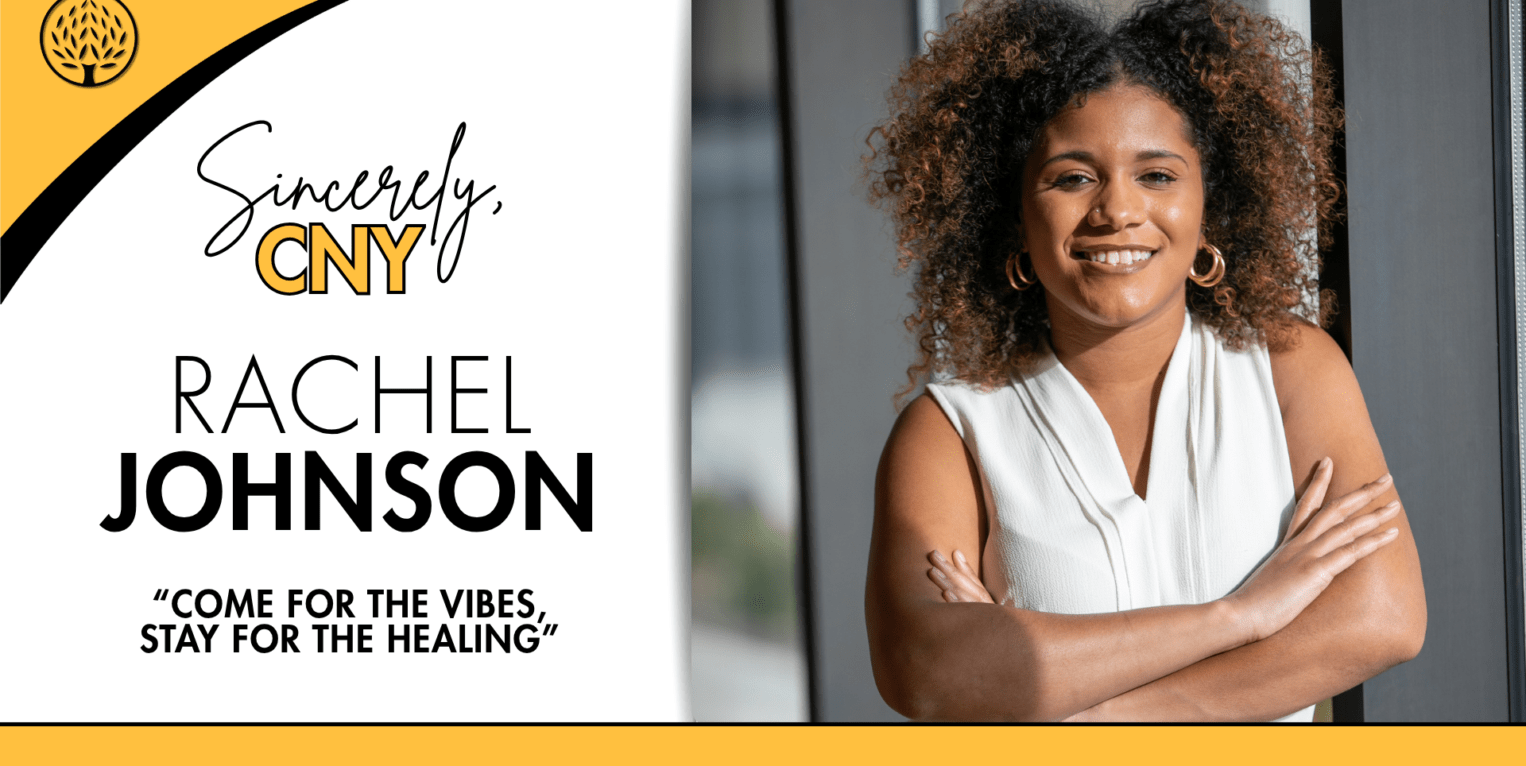
Sincerely, Rachel Johnson: Come for the Vibes, Stay for the Healing (Transcript)
FULL TRANSCRIPT
Melanie: Today’s episode is a love letter to the people who are shaping Central New York in sometimes quiet but profound ways. I’m Melanie Littlejohn, and welcome to Sincerely, CNY.
Today’s guest is a licensed mental health therapist, doula, professor, speaker and founder of Half Hood Half Holistic, where she creates culturally relevant, healing-centered spaces that support personal and community wellness. An author, coach and organizational consultant, she is known for helping individuals and organizations build healthier, more human-centered cultures.
Through her work, Rachel has become a powerful voice at the intersection of mental health, leadership and community empowerment in Central New York and beyond. Please welcome our guest, Ms. Rachel Johnson.
Rachel, thank you so much for being here. I have looked forward to this for a while, so thank you for coming to join me.
Everything I’ve read or seen about who you are, the work you’re doing and the power in the work that you’re doing across Central New York is so inspirational. Part of this podcast is really about how we inspire philanthropy, and philanthropy is just giving to another. Your work is so deeply entrenched in giving to someone else.
Can you talk to me about your journey and the meaning behind Half Hood Half Holistic?
Rachel: Yeah. First of all, thank you for having me, Melanie. I’m not going to cry, but I’m deeply honored to be in this space and deeply honored to be seen by somebody like you in this work.
Melanie: We’re going to both cry right now.
Rachel: I know, because you’re going to make us cry.
I think that’s really powerful. In this world, it’s important to see people. So thank you for seeing me, Mel. I appreciate that.
Melanie: And thank you for seeing me. Thank you.
Rachel: The journey of Half Hood Half Holistic and even Rachel Johnson are intrinsically linked.
I started this work as a bright-eyed, bushy-tailed person who just wanted to help people. I thought I would do that through the path of social work. I came out here — I’m originally from Buffalo — but came out here to Syracuse for school and have been locked in ever since.
As I was practicing and getting these professional degrees, I was really taken aback by how many people were left out of that conversation. I tell people that I went to school and got two degrees in child and family studies and social work in my undergraduate program. Then I got my master’s degrees in marriage and family therapy and social work. Each of those required their own internship experiences and practicums.
At the end of them, I probably had over 2,000 clinical hours, and I could count on my hands how many people of color I served. So there felt like a big gap in clinical services, who was being represented and what kind of care people were able to access.
I tried to make it my mission to bring forth this space where people just felt seen and represented in their care. I really tried to create a space where people felt like they could be authentic, true and real, but also be well. I just had not seen that.
We’re several years into this thing. Half Hood Half Holistic turns five next month, and we’re still learning and growing. It’s shaped into something beyond whatever I could have imagined. I’m grateful and deeply honored to do this work in this community.
Melanie: You just said something that underscores your work: being real and well.
Sometimes I think communities have to begin to think about, what’s the difference between real or well? Is that where trauma enters into the discussion?
Rachel: I think that’s a good piece of it. A lot of the work that you’ll do is reckoning work and trying to figure out, who are you? I ask people to think about who they are without the filters of this world.
Oftentimes, in communities like this, those filters are things like trauma. So the real, the authentic, the voice — searching for those things and being grounded in that often means reckoning with something like trauma or the things that have been placed on us from other people.
That authenticity, being able to show up real, being able to show up true to yourself and true to your community, is the path to wellness. It’s integration work.
When you’re consistently fighting through whether it is trauma or a traumatic past, or trying to navigate systems that were not built or designed to hold you, and when you’re doing all of that work and presenting or performing as something else, trying to survive, it’s disingenuous — and your body feels that.
Being well, for a lot of people, is that reclamation of who you are despite, healed from or moved through these systems, these traumas and the things that have been placed on us.
Melanie: Wow.
When I think about some of the things I heard my first two years here at the Foundation — my first year, I did several rounds of listening sessions because I wanted to hear and connect with what people were saying were the needs of this region. There were things that I knew I was going to hear: issues around workforce, childcare, housing and food insecurity.
But the one thing that came up 10 times bigger than I ever suspected it would was mental health, and the impact that mental health and lack of wellness were having on people in this region. Of course, whatever happens here happens across the nation and arguably across the world.
How have you helped people, especially in Black and brown communities, feel comfortable even broaching the subject around mental health?
Rachel: In this region in particular, it doesn’t surprise me that mental health rises up as a main concern because it’s not separate from all those other factors that you named.
When we talk about the ways in which we have tried to normalize these discussions around mental health and bring them to the forefront, our tagline at Half Hood Half Holistic is, “Come for the vibes, stay for the healing.”
Melanie: Love that.
Rachel: It’s something that I learned just in practice.
When I started working at the local community center down the street on the South Side, I started to learn a few things about what people valued. Syracuse in particular is a very resource-rich place. There are lots of nonprofits. There are lots of people doing community and human service work. But there were lots of low services people coming in.
My work really started as a doula, and it shaped a lot of things. What I learned early on is that it’s not that people don’t want services or care about their health and wellbeing, or that they don’t value those things. What people care about more is connection. They want to feel connected. They want to feel seen.
Half Hood Half Holistic was built on this combination of my experiences. I remember doing maternal health work at the time, and we would host things like Breastfeeding 101 or Baby Carrying 101. People would come to those things, but we weren’t getting a large amount of people participating in these services.
Then we started hosting things like game night, Mommy Needs Me Time and spa days. While they were there, we started talking about things like postpartum depression.
I learned what became the working theory of Half Hood Half Holistic: when people come for the vibes, the connection, the joy and the community — when they come to do the thing that resonates with them most — they are better positioned to receive this education or experience. So they come for the vibes and stay for the healing.
When you get there, you realize, “Oh, I feel connected. I feel respected. I feel seen. I feel safe in this space.” Then you are more likely to start having conversations about things that historically have been stigmatized or seen as taboo in communities.
That’s our model. We really like to show up as “what you see is what you get.” We’re very authentic. We are very keen on the experience we are curating for people.
We don’t plan programs. I tell my team all the time, “We don’t plan programs. We curate experiences where people feel held and seen and safe,” because that is actually what’s necessary for folks to receive information about mental health, resources or get connected to wherever they need to go next.
People are more likely to do that when they feel seen, respected and held in these spaces. That’s how we broach these conversations. We make it very real.
We know clinical language, but we try to use language that is relevant and resonates with folks. We try really hard to build a pathway to care, or entry to care, in whatever way people can engage. Accessibility is at the core of our mission.
Whether you’re Zooming into a session, coming to one of our social wellness events, showing up at a retreat or using whatever entry to care looks like — as long as you’re connected, you’re here. You’re tribe, and we’re going to support you and get you connected where you need to go next.
Melanie: Is there an instance through your work that’s had a profound impact on you? Any stories or experiences? How has it shaped you?
Rachel: That’s a great question.
Every time I log off of a client meeting, leave a retreat space or leave a workshop, I feel energized. I always, 100% of the time, have this deep, profound gratitude that takes me over. I am so honored to be able to do this work, and even more honored that people trust me to hold them in their journeys.
There are several stories. One of the things that we like to lift up is that at Half Hood Half Holistic, we actually serve a large population of Black men and provide services for Black men who are not always traditionally represented in mental health conversations. We serve couples. I’ve been working with some families for years, watching them try to navigate what it feels like to have a healthy relationship when they themselves have never seen that.
We serve people from age 14 easily to 64. I’m watching women in midlife say, “I’m choosing myself, and I want to learn what it looks like to be me without needing to caretake or care for someone else.”
It’s a collection or a collage of experiences. The most powerful thing is that they are also connected. There is not one thread or one theme that is unique to anyone else. It’s linked to other people.
We believe that people heal in community, and so we do a lot of saying, “This is not unique to you. Lots of people are on this journey. Everyone is trying to figure out what it means to love themselves, what it means to come home to themselves, and what their real, authentic or well self looks like.”
I carry stories every single day, and that’s the hard part about this work. We can’t market that. We feel like we make real-time impact, and it’s not as easy as being able to prop up a device or get a quote. It’s such sacred work.
We have clients who were hesitant and never thought about going to therapy, who never would have uttered things like, “I think I have anxiety or depression.” We have served people who have had deep mistrust of the medical and mental health system — rightfully so. All of those things count as wins to me.
I really believe this is the purpose that was downloaded in me, and I get to walk very much aligned in it.
Additionally, I have a team that’s dope. Something about being able to show up authentically as me — Half Hood Half Holistic is me. It’s an extension of me. I built this place not only where other people could see themselves whole and well and healthy, but where I could see myself whole and well and healthy. That, to me, is my mission.
My team is my first mission because when they are well, when the healers doing this work are well and held and seen and restored, then that creates ripple effects for other people to come and say, “You know what? I’m going to go hang out with these people over here.”
Melanie: I have seen you stand in parking lots, in the middle of grocery stores — wherever you are, you’re doing your work.
No, you are leaning into your purpose. Anyone who spends any ounce of time with you, and I hope anyone hearing or feeling this discussion knows, this is what you were called to do. This was your assignment.
The one thing about you that I’ve seen time and time again is that you are generous. It’s almost like you have this spidey sense: let me help walk this person closer to the healing reservoir. Let me help. And you just do it instinctively. That’s a gift.
What you are doing in this region — and not just this region, nationally — most people do not know Rachel Johnson is having a national impact on creating a vibe so that the healing can begin.
Keep doing it. We need you. We need this work in ways that help people live good, healthy and resilient lives that they were always meant to live.
I appreciate you, Rachel Johnson. I appreciate all you do to touch the lives of people here. You are truly a bad philanthropist and healer. I’m grateful for the moment that we got a chance to spend.
Rachel Johnson, thank you.
Rachel: Thank you.
Community Foundation Segment: Vicki Brackens
Vicki: My name is Vicki Brackens. I’m the owner of Brackens Financial Solutions Network here in Syracuse, New York.
I would suggest to everyone, when you’re looking at your estate plan, don’t stop to just look at the mechanics. But what are the dreams that you would like to fuel for the future, and how can you use your estate plan to do so?
The Community Foundation and organizations like this are charged with digging deeply into communities to really identify the needs that are going to need to be funded now and in the future.
You don’t have to have a billion dollars to start. You just need to start.
P.S. The Next Chapter: Melanie Littlejohn and Payton Perry
Melanie: Welcome back. I’m so excited to introduce this next segment.
P.S. The Next Chapter is a spotlight series featuring young leaders from across Central New York who are creating change through generosity, service and action. Each conversation offers a glimpse — just a small one — into the passion and purpose driving the next generation of change-makers in our community.
Our guest this episode is a powerful young man, Payton Perry. Take a look.
Hello, Mr. Payton Perry. How are you today?
Payton: I’m good. How are you doing?
Melanie: Good, good. I’m so glad you were going to spend a little bit of time with me today.
Payton, I was reading your bio. I was looking at all the amazing things that you’re doing — from being a student at CBA, to working with young people and kids on mentoring, to your love of music. You’re a school leader. And then I also see that you know how to handle the rock a little bit. You are a baller as well as a scholar and an all-around good human being.
I’m so excited to spend a little bit of time with you today. Can you start by telling me who Payton Perry is, and what are the things that he absolutely loves?
Payton: I feel like, as Payton Perry, I love helping my community out. I love playing basketball. I love learning new things, and I love to just do different things, if that makes sense. I like to always just learn.
Melanie: Interesting. So you love learning, you love helping your community, you love sports, and I also see you love music — in particular, Ray Charles and Marvin Gaye. We’ll talk about that in a minute. Some of my favorites as well.
What you just said that touched my heart is that you love helping people. That’s part of the story that we think is so important for young people to have their voice and talk about how important helping other human beings is to you.
One of the programs that I heard about was Ties, Tenders and Fries. Tell us about that and why that just made you smile.
Payton: Ties, Tenders and Fries was something my mom and I came together on. She wanted to make an event happen, and she asked me, “What’s something that people in my generation or older need help with?”
I was like, “Mom, I feel like I should teach people how to tie ties.” She was like, “Okay.” I said, “We could add food with that, because people like food.” So we came up with Ties, Tenders and Fries.
There, we taught people how to tie ties. We gave people ties, and me, my uncles and my cousins all taught younger people and older people how to tie ties for important things like business, school or anything in life where you’ll need to tie a tie.
I feel like there are so many people out there who just don’t know how to tie a simple tie. As a man, you should know how to tie a tie. So why not spread awareness to that?
Melanie: What were some of the reactions you got when you would do that program? What did people say to you?
Payton: A lot of older people didn’t expect me to know how to tie a tie. I was honestly shocked, but not really. Other people were fascinated by someone my age helping all these people out. It was a blast, honestly.
Melanie: How often have you done that program?
Payton: That was my first, and I was so nervous. I just went with the flow. At first, I was frozen, but then I told myself I had to be myself and just help people.
Melanie: Because when you are yourself, it naturally has people gravitate to you.
I can already tell just by talking to you for a few minutes that you have this really unbelievable positive spirit.
Payton: Thank you.
Melanie: That’s important, and that’s why we want to feature young people like you — because you have that spirit of service and spirit of giving.
Now, one of the things that you absolutely love is basketball, right?
Payton: Mm-hmm.
Melanie: What position do you play?
Payton: I play the center position, but I know when I get older, my position might change. Right now, I play the center position.
Melanie: As the center, what’s the main thing you have to do on the basketball team?
Payton: The main thing I have to do is talk to my teammates and communicate, be a leader, show people where they need to be sometimes, and be loud and vocal. Not organize the floor, but lead the floor from behind in a way.
Melanie: The most impactful leaders lead from behind.
Payton: Maybe, yes.
Melanie: They do. They know how to see things that need to happen. You tell people where they need to go to make the most impact as the center, right?
Payton: Yes.
Melanie: Do you also help them by bringing out their best skills and telling them how to handle the rock? Do you tell them how to do that? How to handle that ball?
Payton: Sometimes, because I know I’m not perfect. Sometimes I might be too bossy in a way. But if I can see the best in you, I’m obviously going to help guide you so you can help the team out.
Melanie: You got me all emotional over here, Mr. Payton Perry, because I love that you are taking what you love — basketball, community and leadership — and you’re helping to guide and nurture people to do the things that are most important for themselves.
That is so powerful to me.
I think I might know the answer to this question, but who has helped you become the person you are today?
Payton: Besides God, I would say my mom, for sure. I feel like my mom has always set me up in good spots to help me be where I am now. Then God just helps it all come together.
Melanie: Every day. Every day, every moment, right?
You also have used your voice to advocate for people who might have a disability — that which you can see and sometimes that which you can’t. Why is that work important to you?
Payton: I love this question.
I feel like advocating for what’s needed is always the right thing to do, because there’s always going to be something that is not addressed and needs to have a voice on it. Knowing that I could be that voice for it feels good.
Melanie: Why is giving so important to you?
Payton: Giving to me is important because I know if I can give, then a positive can come out of it. I could help change someone’s life, and then that person could go do something cooler than me or something more important, all because of my give.
The possibility that can come from my little give that could change someone’s life means a lot.
Melanie: My last question — and I wish I had time to sit here and ask you 10 more questions — what advice would you give another young person who was trying to develop their confidence? What would you tell them?
Payton: I would tell them to always stick with their first decision. If you have an urge to do something, then why not do it? You only live once, so why not? That one choice can always lead to more doors in your life.
If you have a feeling, then just do it, because you could always impact your community and your environment.
Melanie: I know I told you that was the last question, but I have one more that’s just nagging at my heart.
What would you want people to remember after hearing your story? What do you want them to remember about you and what you’ve said today?
Payton: I want people to take away that I am a nice person, and I’m here to help. People like me can help your city and your community.
Melanie: Payton Perry, you’re an amazing young man. I appreciate everything that I’ve heard about you today, from advocating and being a voice for people with disabilities, to using basketball to be that leader on and off the court, to your love of music — Ray Charles and Marvin Gaye, some of my favorites — to your food choices of chicken tenders and french fries, and oh, by the way, Shirley Temples?
Payton: Oh yes, always.
Melanie: Always, right?
Keep making an impact, Payton Perry. You are doing the work that we are so proud of, and I can’t wait to see how you’re going to change the world.
Payton: Thank you.
Melanie: Thank you. Thank you, thank you, thank you. I look forward to seeing so much more from you.
Payton: It’s been a pleasure. Thank you.
Closing Remarks
Melanie: If you would like to nominate someone to be featured in our P.S. The Next Chapter segment, scan the QR code on the screen or visit cnycf.org/podcast.
When we do this segment, this podcast, it’s really about a call to action. As we heard Rachel Johnson illustrate, it’s really about self-discovery. It’s about connecting to who you are. It’s about taking time to breathe. Taking time to know that you will be okay. Taking time to help be an ally, a partner, a friend in someone else’s journey.
Most importantly, it’s about looking squarely in the mirror every day and doing the work that we have to do on ourselves. Because in order to truly help not only another person, but our communities, we need to also heal ourselves.
So take time. Take time for you, because when you do that, philanthropy grows, our community changes, and the world becomes an even sweeter and better place.
Thank you once again for joining Sincerely, CNY. I encourage you to carry this message and conversation with you. Stay curious, stay connected, and help shape what comes next. Thank you.
News & Stories
A Century of Giving: Building Tomorrow, Together
Sponsorship Opportunities.
Booker T. Washington Center Chosen by Cayuga County Residents to Receive $75K for Youth-Focused Project
The winning grant will be used to create a countywide teen resource program. The program will ...
Cayuga County Residents Invited to Vote on Community-Designed Projects for $75,000
Winning Project to be Announced at October 1 Community Celebration
Tips on getting your stocks in a pile (and other reminders)!
As clients turn their attention to year-end tax and financial planning, now is an ideal ...
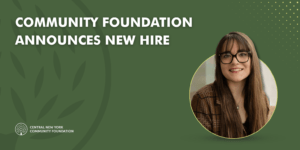
Central New York Community Foundation Welcomes New Hire
The Central New York Community Foundation has hired Madeline Thibault, Esq., as Philanthropic Advisor.
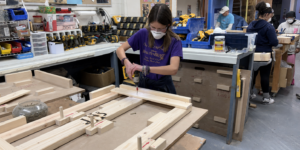
More Than $1.3 Million Distributed to CNY Nonprofits
The Central New York Community Foundation recently distributed $1,301,606 in grants from our Community Fund ...
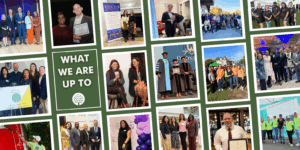
What We Are Up To | CNYCF Staff Updates
Our staff takes pride in not just serving our community but actively shaping its future. ...

Why Your IRA Might Be Your Most Powerful Charitable Asset
Your IRA can do more than fund your retirement. It can also help you support ...
Chamber Chosen by Cortland County Residents to Receive $75K for Expanding Childcare
The winning grant will be used to help the chamber hire a project professional who ...
A Century of Giving: Building Tomorrow, Together
Sponsorship Opportunities.
Booker T. Washington Center Chosen by Cayuga County Residents to Receive $75K for Youth-Focused Project
The winning grant will be used to create a countywide teen resource program. The program will ...
Cayuga County Residents Invited to Vote on Community-Designed Projects for $75,000
Winning Project to be Announced at October 1 Community Celebration
Tips on getting your stocks in a pile (and other reminders)!
As clients turn their attention to year-end tax and financial planning, now is an ideal ...
Central New York Community Foundation Welcomes New Hire
The Central New York Community Foundation has hired Madeline Thibault, Esq., as Philanthropic Advisor.
More Than $1.3 Million Distributed to CNY Nonprofits
The Central New York Community Foundation recently distributed $1,301,606 in grants from our Community Fund ...
What We Are Up To | CNYCF Staff Updates
Our staff takes pride in not just serving our community but actively shaping its future. ...
Why Your IRA Might Be Your Most Powerful Charitable Asset
Your IRA can do more than fund your retirement. It can also help you support ...
Chamber Chosen by Cortland County Residents to Receive $75K for Expanding Childcare
The winning grant will be used to help the chamber hire a project professional who ...